
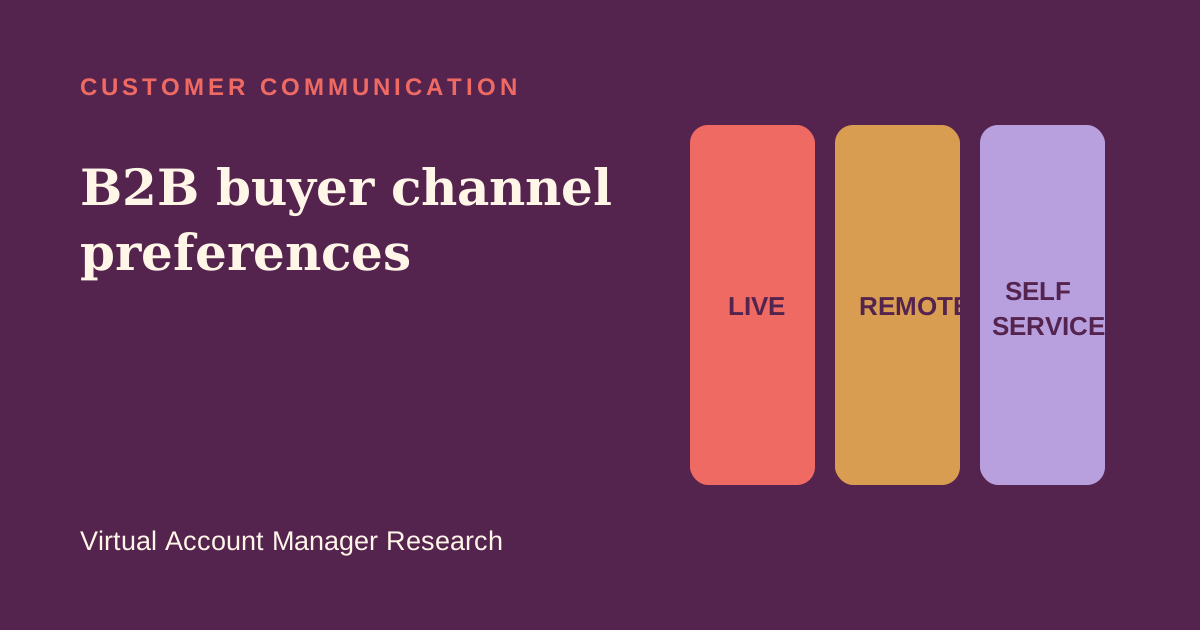
How should account teams respond to the persistent split in B2B buyer preferences across in-person, remote, and digital self-service interactions?
MethodWe reviewed McKinsey's 2024 B2B Pulse analysis, based on nearly 4,000 decision makers across 34 sectors, eight industries, and 13 countries. We interpreted the aggregate finding as a planning signal, not an individual forecast.
Key findings
- At a given buying stage, roughly one third of respondents preferred in-person interaction, one third remote communication, and one third digital self-service.
- McKinsey reports that the pattern persisted across geographies, industries, company sizes, purchase types, and purchase values.
- Account teams still need to ask and record the preference of each stakeholder for each important purpose.
What the survey covered
The 2024 study was the ninth wave of a program that has gathered about 30,000 responses since 2016. Its rule of thirds is a broad market finding, not a precise forecast for one account or stakeholder.
The implication is that a single-channel policy can be convenient internally and still create friction. It does not mean every team must offer every channel.
Turn preference into an account record
Record the stakeholder, journey stage, preferred channel, purpose, accessibility need, date, and source of confirmation. Keep purpose explicit because a stakeholder may prefer a portal for routine documents and a live call for a decision.
Ask, record, and confirm instead of inferring preference from age, title, or past behavior. Treat an old preference as dated evidence rather than a permanent fact.
Design a manageable channel plan
Start with moments where a weak handoff carries the most cost, such as onboarding, scope change, unresolved requests, executive review, and renewal preparation. Name the primary channel, backup channel, owner, and expected record after each interaction.
The channel plan should fit security requirements and operating capacity. A channel that cannot preserve context or ownership may add friction rather than remove it.
Define the support boundary
Within an approved playbook, support staff can update preference records, prepare accessible materials, coordinate calendars, maintain communication logs, and flag unanswered requests. They should not choose a sensitive channel on behalf of a customer when consent or policy is unclear.
Channel choice does not replace message quality. Each interaction still needs a clear purpose, accurate content, accountable owner, and visible next action.
Method and limitations
This brief interprets McKinsey's aggregated survey findings for account operations. The study does not establish the correct channel for an individual customer and does not prove that adding channels will cause growth. Virtual Account Manager did not conduct the survey.